By the Raids du Sud team — guides and mechanics based in Tagounite
A seminar in the Sahara can create a different context for cooperation, provided you start with a clear objective. This guide helps a company frame its incentive, rhythm, and logistics before requesting a proposal.
Discover our 4x4 guided adventure in Morocco and compare the packages suited to your project.
Define the objective before choosing activities
A trip to the desert cannot solve a team's difficulties on its own. The programme must respond to a specific need: welcoming new employees, bringing departments together, celebrating a project, or taking a step back from collective operations. Define what the participants need to share and what you wish to observe, without turning every moment of the trip into an assessed exercise.
A Sahara team building event can combine discovery, cooperation, and discussion time. Space must be left for rest and informal exchanges; a succession of challenges sometimes reduces participant availability. For a Morocco desert seminar, clearly announce the work portion and the leisure portion. Employees must be able to prepare for their trip and understand the expectations, without discovering an imposed competition on-site.
Choose a two or three-day format on-site
A two-day programme may suit a concentrated discovery near a Saharan base. A third day allows for better distribution of activities and travel. In both cases, distinguish the time on-site from the days required to reach the departure point and return. A three-day Morocco corporate incentive does not always offer three full days in the dunes.
The following outline is a framework for discussion, not a booked service or guaranteed availability. The itinerary, vehicles, accommodation, and activities will be adjusted based on dates, the group, and the quote. Terrain, weather, and participant needs may change the order of sequences. It is better to have a few well-organised moments than an unrealistic agenda.
Day 1: welcome, explain, and create crews
Start with a welcome, a presentation of the setting, and a safety briefing. An approach drive on suitable terrain allows for discovery of the vehicles and convoy rules. If employees are driving, their documents, experience, and insurance conditions must be validated before departure. No one should be pressured to take the wheel to prove their commitment.
A first roadbook reading exercise can take place while stopped or under supervision. Roles are divided between reading, observation, and reporting; the guide's instructions remain a priority. At the end of the day, allow a short time to share initial observations: what facilitated communication? What information was missing? The evening and accommodation are then chosen to promote group comfort.
Day 2: cooperate on a discovery route
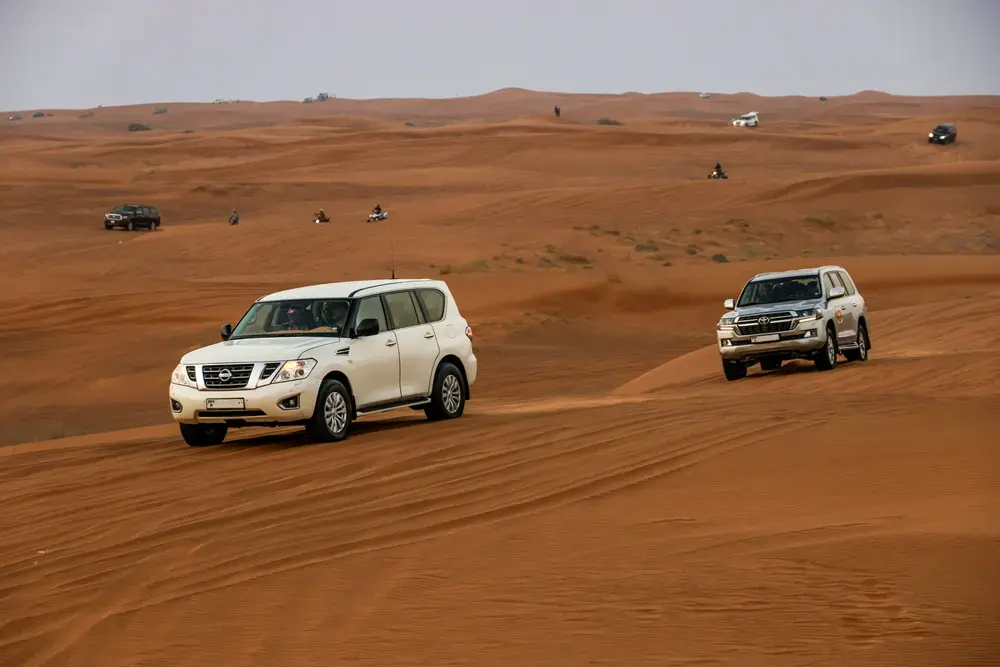
A discovery day can alternate 4x4 stages, short walks, and breaks. Team-building activities are possible when the area and supervision allow: solving a riddle from a roadbook, preparing a stop together, or assigning an observation mission. The exercises must have simple rules and not distract the driver.
Navigation remains supervised: teams are not left to go into isolated areas on their own to win a competition. An initiation to sand recovery can help understand coordination, but only with a professional, suitable equipment, and participants kept out of dangerous zones. In the evening, a desert camp, if provided for in the quote, offers a setting for discussion; it should not be presented as a night of identical comfort for all profiles.
Day 3: take stock and organise the return
When the format includes a third day, plan for a calmer sequence. Local discovery, a sunrise, or a short walk can precede the wrap-up. Ask each group to identify one cooperation practice transferable to work: clarifying an instruction, verifying understanding, or reporting a difficulty early enough. Avoid drawing conclusions about individuals based on a leisure exercise.
The return requires its own margin. A tight schedule between the last activity, a long drive, and a flight can turn the seminar memory into fatigue. Keep the programme compatible with the next day's professional obligations. The end of the stay is also the time to check personal belongings and communicate practical information, not to add a surprise challenge.
Group size and vehicle distribution
Capacity depends on the vehicles actually available, certified seats, cargo, and the level of supervision. No minimum or maximum headcount is announced without validation. Send the planned number and a range of uncertainty; ask what changes if a few participants are added or withdrawn. For a large group, several departures or rotations may be more suitable than a single convoy.
The composition of crews can bring departments together, but it must also respect the needs of the individuals. Check for accessibility, motion sickness, health constraints, and driving preferences. Sensitive information is collected discreetly by the appropriate contacts. Providing a useful role for passengers allows participation without forcing everyone to drive or walk for long periods.
Cohesion activities to be chosen with discernment
Reading a roadbook helps work on information transmission. A landscape observation exercise can develop listening and synthesis skills. Collectively preparing a camp helps distribute concrete tasks. These activities do not require a race between vehicles. They are built around an understandable instruction, an appropriate duration, and a short debrief.
A desert camp evening can host a group exchange or a convivial moment, depending on confirmed possibilities. Music, external speakers, and specific meals are options to be discussed, not implied services. Activities must respect the location, inhabitants, and other travellers. For specialised facilitation or professional coaching, specify if a speaker is expected and who assumes responsibility for them.

Transfers, meals, and seminar space
Identify the arrival city, times, transfers, and nights before setting the agenda. Casablanca, Marrakech, and a base in the South are not interchangeable in terms of travel time. The proposal must specify where the service begins, what is planned for luggage, and alternatives if a participant arrives later. Road travel times will be confirmed for the chosen programme.
Collect dietary needs beforehand and have what can be offered confirmed. For a meeting, check the space, shade, seating, power supply, and connectivity. A Sahara camp should not be sold as an equipped conference room without verification. Plan for offline documents and discussions that remain possible without screens. A short work activity is often more realistic than a long digital session.
Safety, insurance, and responsibilities
Driving, walking, and workshops must have a level of difficulty compatible with the group. The guide explains the instructions and may modify a passage. The presence of a mechanic, when planned, must be distinguished from insurance coverage or medical assistance. Ask about the scope of intervention, means of communication, and the procedure in case of an incident.
The company must check its obligations with its competent contacts and confirm the necessary insurance. The responsibilities of the organiser, transporters, drivers, and participants must be legible in the contractual documents. A general certificate is not sufficient if the planned activities are excluded. Do not present cancellation insurance, repatriation, or professional coverage as automatically included.
Building a transparent corporate budget
The quote can distinguish between supervision, vehicles, transfers, accommodation, meals, activities, and any guest speaker. Add personal expenses and excluded items to obtain a realistic budget. Prices remain per corporate proposal: publishing an amount per person without knowing the headcount and services would not allow for a reliable comparison.
Specify invoicing needs, the contact person who validates the programme, and desired payment terms. Ask how changes in headcount and cancellations are handled. To manage the budget, adjust options or duration before reducing essential safety elements. Keep a single version of the confirmed programme to avoid differing expectations between decision-makers and participants.
Information to send for a corporate proposal
Present your objective, possible dates, headcount, departure city, and the number of days actually available. Indicate the desired comfort, the amount of driving, meeting needs, and important constraints. The team will be able to propose a framework and specify the services to be confirmed. The quality of a seminar is prepared in this framing: a spectacular desert does not replace an organisation adapted to the people.
Frequently asked questions
What size of group can participate?
The headcount must be validated according to the vehicles, accommodation, and supervision available. Send over the planned number and the group's requirements; no unconfirmed maximum is announced.
Can we plan a two-day seminar?
A two-day format on-site can be studied. You must add the time required to reach the base and return. The proposed outline is illustrative and will be adapted upon request.
Do employees have to drive?
Not necessarily. The distribution of drivers and passengers and the vehicles must be confirmed before booking. Useful participation in the activities is possible without requiring everyone to drive.
Is insurance included?
The quote and contractual documents specify the cover and exclusions. The company must check its own obligations and not assume that general insurance covers all activities.
How do I request a company proposal?
Communicate your objective, dates, group size, departure city, duration, and desired comfort level via the quote request form. Add requirements for meetings and invoicing to receive a tailored proposal.