By the Raids du Sud team — guides and mechanics based in Tagounite
This checklist concerns preparation, not choosing a new route. For circuits and stages, consult our 4x4 travel guide to Morocco; here, verify what must be ready before leaving the road.
Discover our 4x4 guided adventure in Morocco and compare the packages suited to your project.
Documents: gather and verify
Prepare your identity documents, the license appropriate for the vehicle, the vehicle registration or rental agreement, and insurance certificates. Check their validity for the entire duration of the trip. Requirements may vary depending on your country of residence and your personal situation; consult the relevant authorities rather than old forum discussions. A rental company's terms may add specific obligations to the contract.
For a vehicle registered abroad, inquire about the applicable Moroccan customs formalities before departure. Also, verify the necessary documents if you are not the owner of the vehicle. Do not confuse circulation authorization, insurance, and temporary admission: these are distinct subjects. Keep copies available offline, separate from the originals, as well as the contact details for your insurer and the tour operator.
Insurance: have the intended use confirmed
Ask if your coverage allows for tracks, sand, and the areas included in the programme. Road warranties do not automatically cover all off-road use. Check the declared drivers, passengers, exclusions, excesses, and assistance rules. A written response must correspond to the vehicle and the trip being planned.
Distinguish between vehicle damage, liability, assistance, medical care, and repatriation. The presence of a guide or mechanic does not replace any of these warranties. Ask about the procedure in case of an incident and keep useful numbers accessible without a mobile network. For a group, each crew must understand their own situation rather than relying on a certificate belonging to another participant.
Mechanical preparation: check before loading
Plan a check of the brakes, tyres, spare wheel, cooling system, fluid levels, and suspension components. Have any vibration, leak, or warning light diagnosed before you leave. Verify recent work with a test drive; a repair carried out the day before without a check can complicate the first stage. The spare parts to take must be adapted to the specific model.
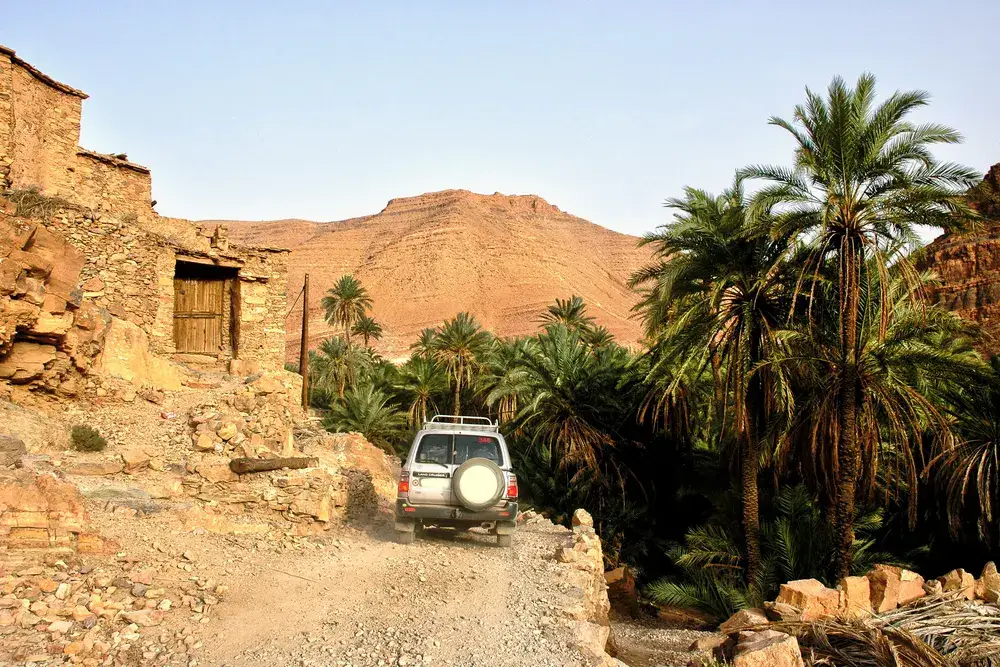
After loading, respect the authorised weights and check the fastenings. Heavy luggage must be secured and placed without hindering passengers or visibility. Excessive or poorly distributed loads change the vehicle's behaviour on roads and tracks. Present the fully prepared vehicle to the supervisor, with its tyres and accessories, to validate the planned routes.
Crossing: bring equipment you know how to use
Sand ladders, a compressor, and a pressure gauge can be useful, depending on the route. Check the recovery points provided on the vehicle and the equipment recommended by the professional. A tow strap, winch, or jack does not make someone autonomous if they have not mastered the associated risks. Recovery is carried out with a person in charge and with all other people clear of dangerous areas.
Do not improvise a tow using an attachment point not designed for this purpose. A poorly prepared operation can be more dangerous than the initial sand entrapment. Ask which tasks you can perform and which must wait for the guide. Distribute collective equipment within the group, checking who is carrying it, who is checking it, and how to access it when vehicles are fully loaded.
Navigation: plan for more than just an app
A GPS or application must be configured and tested before departure. Download the necessary maps and check their accessibility offline. Provide a reliable power supply and an appropriate backup solution. A roadbook can help read a stage, but an old track log does not guarantee authorised access or that a track is passable after rain or wind events.
In a guided 4x4 adventure, the briefing sets the convoy rules and means of communication. Know where to wait if you lose contact and how to transmit your position. Do not drive off to search for another vehicle at random. When travelling independently, a backup plan and real skills are essential; isolated sectors are not a testing ground to learn using only a phone.
Fuel and range: calculate with an appropriate margin
Fuel consumption changes with the load, sand, tyres, and detours. Use reliable observations for your vehicle and discuss refuelling with the guide. A distance announced on-road does not allow one to deduce the range in the dunes. Confirm the petrol stations or supply points in the programme, especially when stages move away from main routes.
Transporting a fuel reserve requires appropriate equipment, safe storage, and compliance with applicable regulations. Do not place an improvised container in the passenger compartment. The necessary margin depends on the stage and fallback solutions; no universal volume is prescribed in this article. The decision is prepared before leaving the last confirmed refuelling point.
Water, health and personal equipment
Keep water accessible while driving and during stops. The quantity to plan for depends on the heat, the number of people, meals, the duration, and the remoteness of the sector. Have the collective and personal reserves clarified; do not assume a small bottle is enough because the journey seems short. Heat and fatigue must lead to regular breaks.
Bring your regular treatments, sun protection, clothing adapted to both day and night, closed shoes, and a headlamp. Ask about the type of bedding for nights in the desert camp. Inform the operator of any significant constraints with discretion. A first-aid kit must match the available skills; it does not replace medical care or suitable insurance.
Before departure: a check with each crew
- Valid documents and offline copies.
- Insurance and track usage confirmed in writing.
- Mechanical check completed, vehicle tested while loaded.
- Tyres, spare wheel, and tools checked.
- Luggage secured and authorised weights respected.
- Maps, GPS, power supply, and roadbook prepared.
- Refuelling and range discussed with the guide.
- Water, clothing, bedding, and treatments available.
- Assistance contacts and convoy instructions understood.
- Nights, meals, inclusions, and exclusions confirmed in the quote.
Use the downloadable version to note checks and missing information. Do not tick a point simply because an accessory is present: ensure it works and that you know how to use it. The checklist is used to prepare for a concrete discussion with the team.
Upon return: keep useful lessons
Check tyres, the underside of the vehicle, fluid levels, and fastenings after the track. Report any shocks or symptoms observed to a professional and avoid driving for long on the road with an anomaly. Note what was missing, what was unnecessary, and the settings validated for your vehicle. Successful preparation is extended by maintenance and improves the next departure, without turning a specific experience into a universal rule.
Frequently asked questions
Does this checklist replace a professional check?
No. It helps organise checks and questions. Vehicle capability, repairs, and modifications must be evaluated by a competent professional.
What customs documents should you plan for?
Formalities depend on your vehicle and your situation. Check current requirements with Moroccan customs before departure and keep the necessary proof of documents.
Can you prepare the GPS only with a phone?
A phone can be part of the equipment, but battery life, offline maps, and a backup solution are important. Skills and a contingency plan count as much as the device.
Where can you find the itineraries?
The 4x4 Morocco travel and road trip guide and the tour pages describe the stage proposals. This article voluntarily focuses on preparation.