By the Raids du Sud team — guides and mechanics based in Tagounite
The best period depends on the sector, the pace of the trip, and your tolerance for heat or cold at night. This calendar helps to prepare a departure in Southern Morocco without confusing seasonal trends and weather forecasts.
Discover our 4x4 guided adventure in Morocco and compare the packages suited to your project.
A pleasant season does not erase differences in terrain
Between a stage at altitude, a palm grove in the Drâa Valley, and a night in the dunes, conditions can change significantly. Therefore, do not choose a date based solely on a temperature forecast for Marrakech. Identify the places where you will be driving and sleeping, then consult local forecasts closer to your departure date. A climatic average cannot predict the wind or a downpour on the day of your stage.
Autumn and spring are often sought after for a balance between daytime warmth and evening coolness. Winter can be suitable for a well-equipped trip, but the nights are more demanding. Summer requires more precautions and sometimes a change of itinerary. No month guarantees clear skies or tracks that are passable everywhere: the state of the terrain remains a daily decision-making criterion.
Sahara calendar: monthly points of vigilance
The numerical indicators relate to the vicinity of Tagounite, at the modelled point 30.03° N, 5.58° W. These are the monthly averages of daily maximums and minimums from NASA POWER, calculated over 2001–2025 based on MERRA-2 data. The average maximum provides a daytime reference, the average minimum a nightly one: these are neither records nor a forecast. Altitude and other sectors of the Sahara may present different conditions.
| Month | Day: average maximum (°C) | Night: average minimum (°C) | Sandstorm: vigilance | Crowd levels: verification | Recommendation |
|---|---|---|---|---|---|
| January | 19.6 | 5.2 | Gusts to be checked locally | Camp availability | Sleeping gear and warm layers |
| February | 21.7 | 6.6 | Plan for sand protection | Holidays in your country | Plan for fluctuations and wind |
| March | 26.3 | 10.0 | Retreat in case of sandstorm | Availability to be requested | Protection against sand |
| April | 30.7 | 14.1 | Local forecasts to be consulted | Holiday calendars | Water, breaks, and light clothing |
| May | 35.0 | 18.3 | Route to be adapted to wind | Dates and bank holidays to check | Early starts and hydration |
| June | 39.9 | 22.9 | Monitor heat and dust | Check camp opening | Evaluate the interest of the route |
| July | 43.7 | 27.4 | Check conditions daily | Available programme to be confirmed | Adapt or postpone programme |
| August | 42.5 | 27.0 | Monitor forecasts and visibility | Actual service availability | Avoid prolonged physical effort |
| September | 37.2 | 22.8 | Do not assume light wind | Check resumption of programmes | Do not anticipate coolness too early |
| October | 31.2 | 17.3 | Keep route flexibility | Holidays and camp spaces | Keep a warm layer |
| November | 24.5 | 10.9 | Check gusts before the stage | Availability to be requested | Check desert camp equipment |
| December | 19.9 | 6.6 | Local forecasts essential | Holiday period to be checked | Bedding insulation essential |
The wind and crowd columns are checks to perform, not measurements: we do not have validated monthly statistics. Consult the local weather and ask for actual camp availability before deciding.
Departing in spring: light, wind, and route flexibility
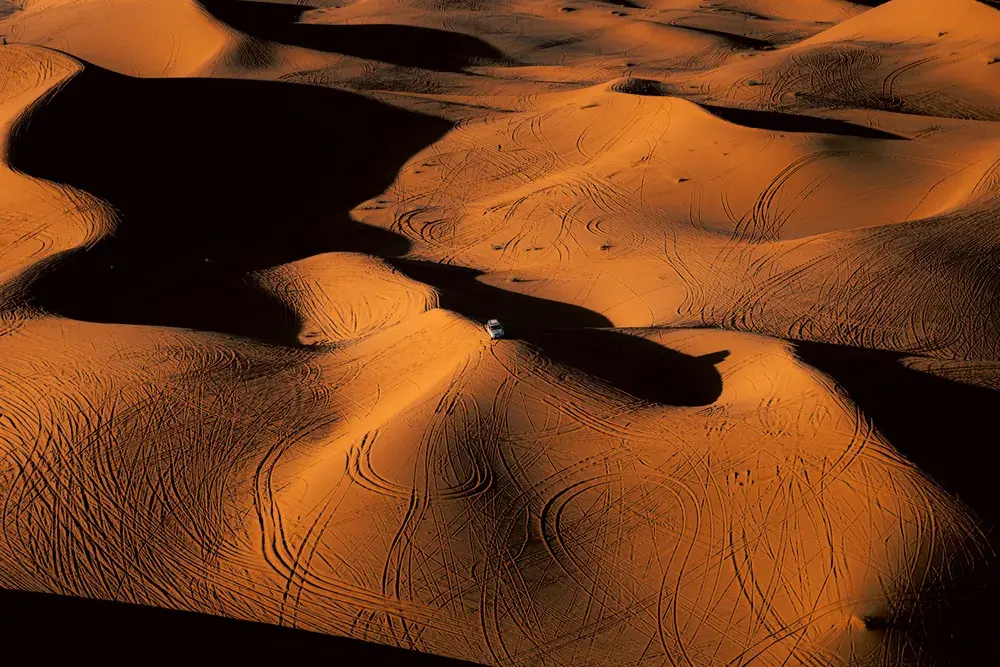
A spring trip often allows you to enjoy varied stages without seeking only shade. Days can nevertheless become hot, and the wind can shift the sand. Prepare protective glasses and a covering fabric, without forgetting that these accessories do not make driving with reduced visibility safe. If the guide changes a stage, the change is primarily a response to the observed situation.
For travellers sensitive to sand, ask about the exposure level of the accommodation and fallback solutions. Allergies, treatments, or special needs must be taken into account before departure. Organise camera equipment in a closed bag and avoid changing a lens in the wind. Equipment and passengers appreciate the same sheltered breaks.
Autumn: prepare for the evenings too
After the summer, the return of more bearable conditions is not immediate in all sectors. September can still be hot. In October and November, keep clothing adaptable: an outfit that is comfortable at noon may not suffice after sunset. A windbreaker jacket and an insulating layer take up little space and avoid relying solely on a campfire.
Holiday periods may increase demand for certain departures and accommodation. This is not a reason to assume that a camp will always be fully booked or that a rate will systematically be higher. Ask for real availability for your dates and compare services. Booking early is primarily useful when you have little flexibility on the calendar.
Travelling in winter: comfort is prepared before the camp
The main challenge of a winter desert camp is often the night rather than daytime driving. Check the type of shelter, the mattress, the insulation, and the comfort temperature of the bedding according to the forecasts. A simple stack of blankets does not always replace suitable equipment. Ask if overnight stays in indoor accommodation can be planned when relevant.
Stages passing through the Atlas may encounter different conditions from those in the desert. Road access may be disrupted while the Saharan destination appears welcoming. Keep an arrival margin and follow information from the authorities. Do not try to maintain a planned crossing at all costs when the guide or authorities recommend another route.
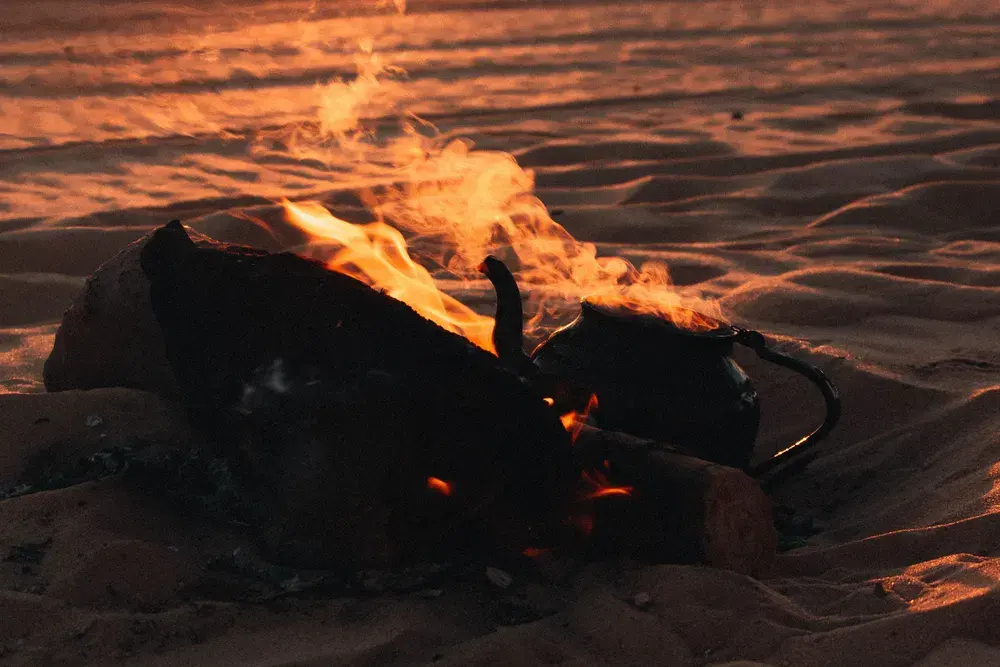
In summer, change the programme rather than minimising the heat
Heat affects fatigue, hydration, and vehicle performance. Air conditioning does not solve the constraints of stops, getting stuck in sand, or a hot night. For a family, participants who are not acclimatised, or people with medical needs, another season may be preferable. Discuss postponement frankly instead of considering any itinerary as passable all year round.
If a programme is maintained, times, stages, and accommodation must be studied with the organiser. Available water, breaks in the shade, vehicle management, and assistance resources become essential. A very early start does not authorise neglecting the rest of the day. The expected comfort must be realistic and specified in the quote.
Rain, wind, and events: check the right information
A dry wadi is not a guarantee of passage, and a downpour upstream can change the local risk. Do not cross a water flow without a competent assessment. After a wind event, the visible tracks and the difficulties of a track can change. The roadbook complements field observation; it does not replace it.
Festivals, local events, and religious calendars can influence services and organisation. Dates change and must be verified for the year of departure with official sources or organisers. Plan without promising a festival or ceremony that has not been confirmed. The value of the trip remains the discovery of the South, not a hypothetical event.
A simple method to choose your departure
Start by indicating your possible dates, your desired destination, the presence of children, and your type of bedding. Then compare two programmes rather than one: a more Saharan route and a variant with more inhabited stages. A few days before departure, confirm the equipment and conditions with the team. On-site, accept the necessary adaptations: it is a normal part of a seriously prepared trip.
Frequently asked questions
Which month guarantees the best weather?
None. Spring and autumn are often sought after, but conditions vary according to altitude and sector. Check local forecasts and confirm the programme with the team before departure.
Can you sleep outside in winter?
That depends on the forecast, the shelter, and the equipment. Ask about the comfort temperature rating of the sleeping bags and the availability of enclosed accommodation. Cold nights must be anticipated, not compensated for at the last minute.
Can wind affect a guided 4x4 adventure?
Yes. Reduced visibility or changes in the sand can justify a stop, a diversion, or a postponement. Field decisions take precedence over the initial schedule.
Do I need to book far in advance?
It is useful if your dates are fixed or if you have specific accommodation requirements. Availability and prices must be confirmed for your group; there is no single lead time that applies all year round.