By the Raids du Sud team — guides and mechanics based in Tagounite
A first off-road trip is not prepared like an outing on the road. This guide helps beginners choose an accessible guided adventure, understand the role of supervision, and ask the right questions before departure.
Discover our 4x4 guided adventure in Morocco and compare the packages suited to your project.
Start with a suitable route, not a performance
The right first guided 4x4 tour is one that leaves time for learning. A succession of long stages or a goal of spectacular obstacles can make the trip tiring without providing much more in terms of discovery. Describe your experience honestly: have you ever used low range, driven on a stony track, or driven for several hours in a fully loaded vehicle? The guide can then propose a progressive itinerary.
Duration alone does not measure difficulty. Three days exclusively dedicated to technical dunes can be more demanding than a week alternating between roads, simple tracks, and visits. Ask about the nature of the terrain, bypass options, planned driving times, and breaks. A 'Discovery' package can be a starting point for discussion, but the chosen programme must take into account your skill level and the season.
Permits, insurance, and documents to check
If you are driving, check the validity of your licence and the conditions applicable to your situation with the competent authorities and your insurer. A personal vehicle, a rental vehicle, and a vehicle driven by a professional do not involve the same procedures. Do not assume that an international driving permit is always mandatory or always unnecessary: the answer depends, among other things, on the country of issue and the rules in force.
Gather your identity documents, the vehicle registration document or rental contract, insurance certificates, and assistance contact details. For entry into Morocco with a foreign vehicle, find out about customs formalities before your trip. Keep offline-accessible copies separate from the originals. Explicitly ask if driving on tracks and in sand is authorised by the contract and covered by the insurance.
Choosing a vehicle without confusing an SUV with a true off-roader
A high body or four-wheel drive is not enough to make a vehicle suitable for all tracks. Weight, tyres, ground clearance, transmission, recovery points, and mechanical condition all count. The programme must be validated for the vehicle actually being used, not for a theoretical model photographed in a brochure.
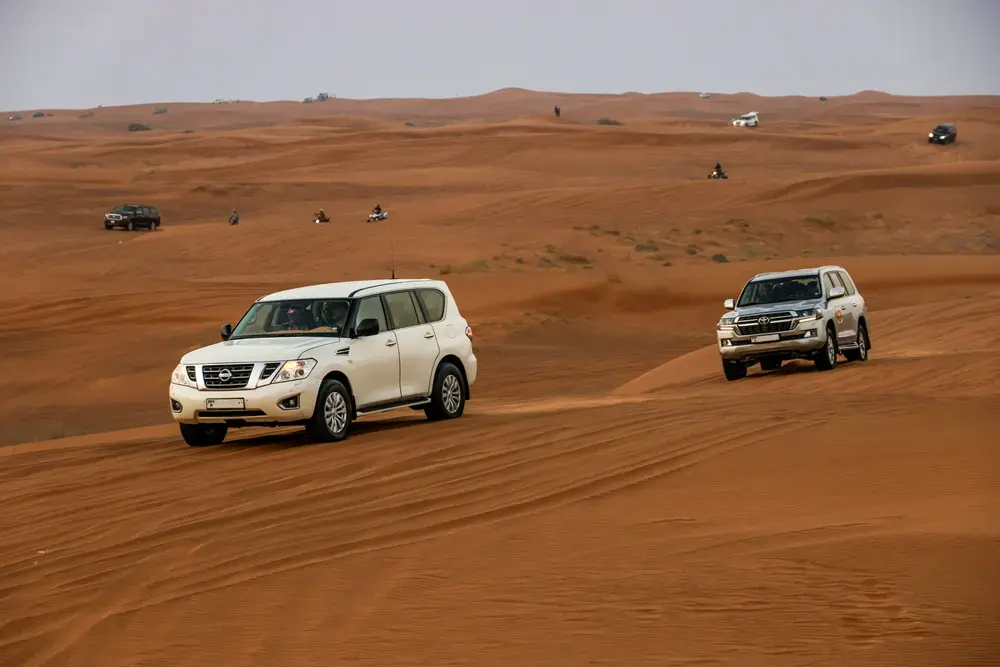
A pre-departure check should cover the brakes, tyres, spare wheel, fluid levels, cooling system, fastenings, and suspension components. It is better to identify a weakness in a workshop than in an isolated area. Avoid last-minute modifications without a test run while loaded. Inform the lead guide of any installed accessories and the potential limitations of the vehicle.
The briefing: understanding the rules before driving
The briefing explains the convoy order, distances between vehicles, stops, communication methods, and the procedure if a crew loses contact. Ask how to signal a difficulty and where to wait. The principle is simple: no hesitation should force a beginner to improvise alone in the desert.
Before a difficult section, listen to the guide's reconnaissance and ask your questions while stopped. The driver must remain focused on their path; passengers should not give contradictory instructions. If a manoeuvre seems beyond your ability, say so. An easier solution or a change of driver is better than taking a risk to keep up with the group.
The first steps for driving in sand
In sand, watch your path and anticipate rather than making multiple abrupt corrections. Excessive acceleration can dig in under the wheels; a poorly positioned stop can complicate restarting. Techniques for climbing, descending, and getting out of a sand trap should be practiced under supervision in an area chosen for learning, never on a dune approached blindly.
Tyre pressure is decided based on the vehicle, its load, its tyres, the terrain, and the professional's instructions. There is no universal value to copy from an article. A reliable pressure gauge and a compressor allow you to check and reinflate before returning to the road. Reduced pressure also requires adapted driving to limit the risks of the tyre coming off the rim or causing damage.
What to do if the vehicle gets stuck in the sand?
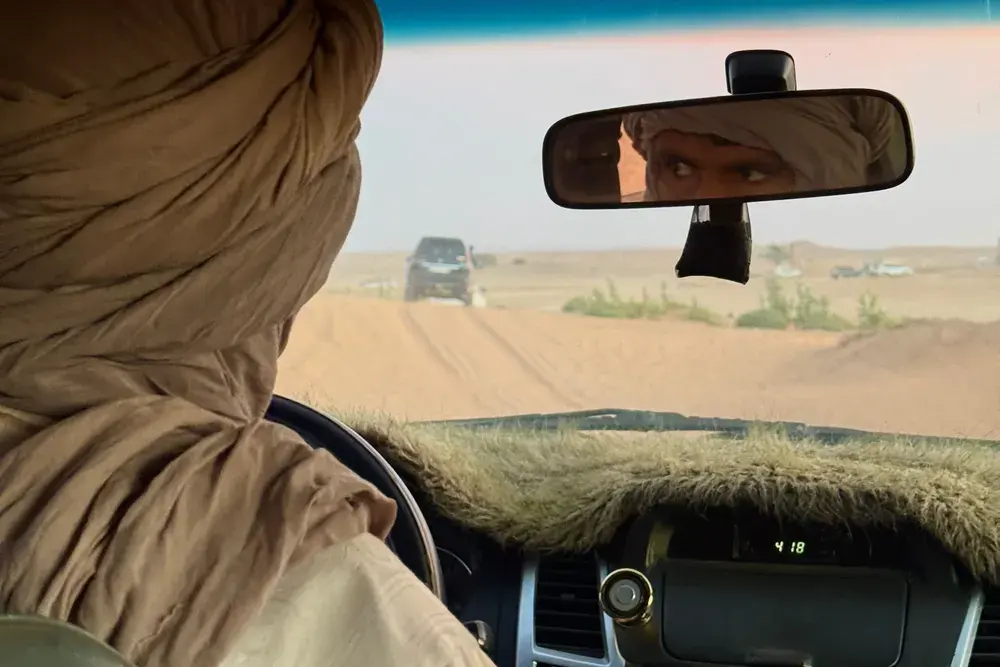
Stop spinning the wheels and alert the guide. Before any intervention, move people to a safe position away from the vehicle's movement. Clearing sand, using sand ladders, and choosing a new path may be enough. The choice of pulling or winching is the responsibility of a trained person, using proper recovery points and adapted equipment.
Never stay in the path of a tensioned strap and do not use an improvised tow point. Recovery equipment can become dangerous when poorly chosen or incorrectly used. A serious initiation also explains what not to do. Unsticking is a collective, organised operation, not a display of strength.
Preparing simple and useful personal equipment
Carry accessible water, lightweight covering clothing, sun protection, a hat, sunglasses, and a warm layer for the evenings. Bring your usual medications and discretely report any medical constraints that may influence the programme. A headlamp and an external battery are useful when accommodation is far from a regular power supply.
Stow heavy objects and luggage so they cannot shift inside the cabin. Closed shoes are preferable for walking on uneven ground or helping to set up a desert camp. Check what the organisation actually provides: sleeping gear, meals, water, collective equipment, and assistance must appear in the proposal. A short, understood list is better than an accumulation of unused accessories.
Arriving rested and keeping a margin
Fatigue affects concentration long before one feels unable to drive. Avoid arriving at the start immediately after a long night drive. Breaks are not wasted time: they allow you to drink, check the vehicle, reread the next stage, and enjoy the scenery. The pace must remain compatible with the passengers.
To choose your first route, present your vehicle, your experience, your dates, and the people travelling with you. Then compare an initiation session around Tagounite with a longer circuit. You will be able to gradually increase the difficulty during a future trip. The memory of a successful first guided 4x4 adventure depends more on good preparation than on the size of the dunes crossed.
Frequently asked questions
Do I need to already know how to drive in the dunes?
No, not for all programmes. Declare your lack of experience and ask for a progressive introduction with bypass options. An itinerary advertised as technical is not automatically suitable for a beginner.
Can I participate without driving?
Ask if a passenger seat with a driver is available for your dates. This option, the vehicle, and the price must be confirmed in a quote; they are not included by default in all packages.
What licence is required to drive?
A valid licence suitable for the vehicle is required. Check the formalities applicable to your country of issue, your contract, and your insurance with the relevant authorities before booking.
Does road insurance cover tracks?
Not necessarily. Request written confirmation for the intended use, exclusions, excess, and repatriation. The supervision provided for a guided 4x4 adventure does not replace appropriate contractual cover.